 Administration > Application Administration > Repositories Administration > Service Level Management Business Rules Repository > MTBF (Mean Time Between Failures) - Alternate
MTBF (Mean Time Between Failures) - Alternate
Service Level Management also uses an alternative method for calculating the mean time between failures: the total uptime divided by the number of outages. The total uptime is the tracking period minus the total outage duration.
This rule needs the results of an Outages rule (for the relevant time interval) to perform its own calculations. You must previously assign the Outages KPI to the appropriate CI (for details, see Defining an SLA: Outages).
Service Level Management calculates the MTBF on a daily basis (24 hours), and takes into account only the outages that occur in the specific time interval. For example, if the time interval is Business Hours (that is, 9:00 AM to 5:00 PM), then outages that occur at 3:00 AM are not considered.
This is a sibling rule.
Example
During SLA creation, you set objectives for an MTBF - Alternate KPI as follows:
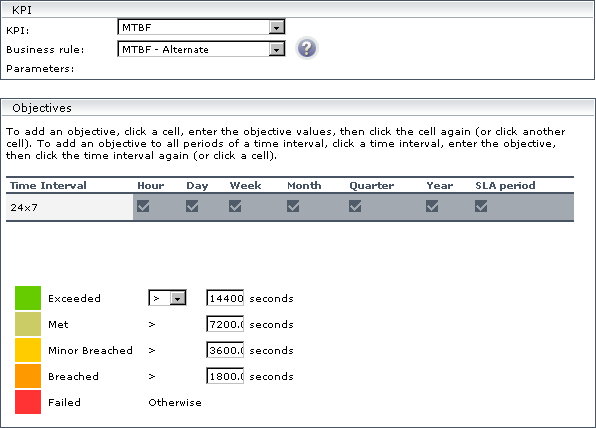
The Outage Summary report shows the following outages that occurred during the Business Hours time interval:

At report generation time, Service Level Management makes the following calculation:
Total uptime = tracking period - total outage duration
= 9 - (30 + 180 + 30 mins.) = 9 - 4 = 5 hours.
MTBF - Alternate = total uptime / number of outages
= 5/3 = 1.666 hours = 6000 seconds.
The CI receives a status of Minor Breached (the status color is yellow).
KPIs
This rule is used by the following KPIs: