 Administration > Application Administration > Repositories Administration > Service Level Management Business Rules Repository > Children Success Ratio
Children Success Ratio
The Children Success Ratio rule enables you to compare, in the same report, CIs that measure different types of activity, for example, with different targets or calculation results. For example, an SLA that monitors an application server can include a CI to measure the server CPU (in MBs) and another CI to monitor the server memory (in percentages).
Service Level Management calculates the status of each child CI (as a percentage). A child CI is considered successful if its status is greater than, or equal to, the Success Status parameter defined in the Children Success Ratio rule.
This is a group rule.
Example
During SLA creation, you set objectives for a System Performance KPI as follows:
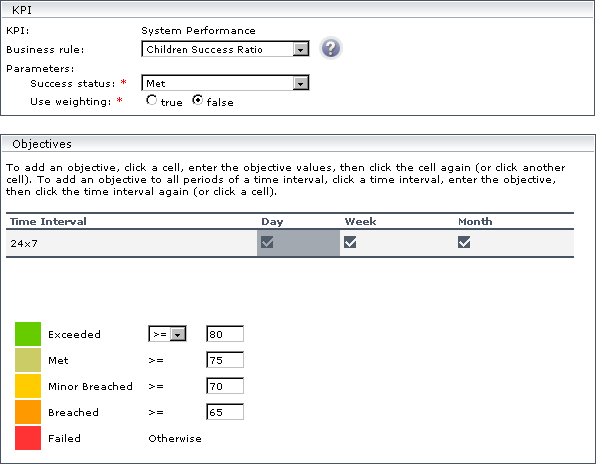
The Success status parameter is defined as Met. That is, any child CI is considered successful if its status is greater than, or equal to, Met (in the above case, 75%).
The System Performance KPI has three children: CI1 (measures CPU), CI2 (measures memory), and CI3 (measures ping time). At report generation time, CI1 receives a status of Exceeded (considered successful), CI2 receives a status of Minor Breached (considered failed), and CI3 receives a status of Met (considered successful). Two child CIs out of 3 are successful.
The KPI result, therefore, is 66.67%. This gives the SLA a Breached status (the status color is orange).
KPIs
This rule is used by the following KPIs:
Parameters
The rule parameters are: